
Commercial solar opportunity assessment

What could your
roof or car park
generate?

Your roof or car park could be one of your business’s most valuable untapped assets. Answer two questions about your building and see an indicative system size, generation, savings, export income and payback in under a minute. No technical detail needed, no quotation, no sales call to unlock it.

This is an indicative overview, not a quotation. Every commercial property gets a bespoke evaluation and an engineer-led system design before we make any formal recommendation.

Engineer-led commercial solar from a family-run company near Milton Keynes · Installing since 2015.

Unused roof or working asset Drag to compare
Today£0 generated As a solar asset£19,900 a year
Roof doing nothing1,000 m²
Could carry108 kWp
Simple payback4.9 years
Engineer-led commercial installers · trading in solar since 2015
MCS CertifiedRECCTrustMarkTSI Approved CodeOctopus Trusted PartnerLuton Council Framework
The journey

Six stages, no jargon

The first four stages happen on this page and take about a minute. The last two happen with a person: a site visit, then a proposal designed around your building rather than a generic package.

1

Select your property

Building type, rough size, and what you spend.

2

Discover your opportunity

System size, generation, savings and payback.

3

Understand the opportunity

How we got there, and what we assumed.

4

Download your report

A branded summary you can circulate.

Offline5

Book a commercial assessment

A specialist surveys the building properly.

Offline6

Receive a tailored proposal

Bespoke design and full financial projections.

The assessment

See what your building could do

Two questions, then the figures. Nothing is gated until the report, so you can look at the numbers first and decide whether they are worth a conversation.

5Book a survey6Your proposal
Step 1 of 6

Select your property

Start with the building you own or manage. Everything after this adapts to it.

Step 2 of 6

Discover your opportunity

Based on your two answers. Change either one and every figure moves with it.

These figures are intended as an initial guide only. Actual system size, generation, savings and payback will depend on your building, energy consumption, site conditions and final system design following a detailed commercial assessment.

Step 3 of 6

Understand the opportunity

No further calculations. Open whichever of these you want to see.

No black box. This is the chain we ran, using your two answers and published commercial benchmarks.

Your roof
less an allowance for plant, rooflights, walkways and edge zones
Usable roof
at roughly 6 m² per kWp for a spaced flat-roof array
System sizeabout panels
at a regional yield of 900 kWh per kWp a year
Generates
of it is used as it is generated. We never let solar cover more than of your a year, because none of it arrives at night or in the depths of winter.
Used on site
Exported
Benefit a year
Installed costat per kWp
Simple payback

Simple payback is capital cost divided by first-year benefit. No finance cost, no inverter replacement, no maintenance, and no allowance for your money being worth less over time. It is the most conservative honest way to put it at this stage.

Every number below is an assumption. None of them has been confirmed by The Green Way Solar’s engineering team yet, and each one needs signing off before this tool goes anywhere near a customer.

Assumed · awaiting engineering sign-off

What we assumedValueWhy it matters
Electricity import price28p per kWhYour blended commercial rate including non-commodity costs. The single biggest lever on the whole model.
Export price6.5p per kWhWhat exported electricity earns. Depends entirely on the contract you can secure.
Generation yield900 kWh per kWp a yearCentral case for this region. We model 850 to 1,000 to produce the ranges.
Usable roof fraction65%What is left after plant, rooflights, walkways, edge zones and access.
Daytime coincidence ceiling65% of consumptionThe most of a year’s electricity that on-site solar can displace. Without it the model would claim solar wipes out an entire bill, nights and winter included.
Roof area per kWp6 m²Spaced rows on a flat commercial roof. A pitched in-plane array needs less.
kWp per parking bay2.5 kWpFor solar car park canopies, which bypass roof area entirely.
Installed cost£650 to £1,100 per kWpSliding by system scale. Car park canopies are modelled separately and higher.
Panel degradation0.5% a yearOutput loss used only in the twenty-five year view.
Energy price inflation5% a yearIndustry default. Used only in the long-term view, never in the payback figure.
Carbon factor0.207 kgCO₂e per kWhGrid displacement factor. Vintage and source need confirming before publication.
Tenant recharge rate22p per kWhLandlord archetype only. What a tenant might pay, at a discount to their grid price.

Two figures on this page did not come from us: the £600 to £1,200 per kWp installation benchmark and the four to six year typical payback. Both came from The Green Way Solar.

An empty commercial roof is not neutral. It is a depreciating surface that costs money to maintain and earns nothing, sitting on top of a building that buys every one of its kilowatt hours at the full import price.

Payback is only the first chapter. The reason commercial solar keeps getting stronger is that you are buying twenty-five years of electricity at today’s price, while the electricity you did not buy keeps getting more expensive.

Cumulative net position over twenty-five years

Starts at minus the installed cost, then adds each year’s benefit. Modelled with 0.5% annual output degradation. The two lines show the same system with and without energy price inflation.

Energy prices rising 5% a year Energy prices flat
25 year net position
If prices never rose
Value of energy inflation alone

Alongside that sit the operational savings that never show up in a payback calculation: fewer exposure points to tariff volatility, a stronger EPC, a reportable Scope 2 reduction, and a building that is easier to let, refinance or sell.

Commercial solar does not necessarily require a large upfront capital investment.

Asset finance could allow eligible businesses to spread the cost of a commercial solar installation over an agreed term, helping preserve capital for other business priorities.

This is a way of funding the project, not a change to the numbers above. Everything on this page is modelled on a capital purchase, and the payback figure stays what it says it is: capital cost divided by first-year benefit, with finance costs excluded.

Capital purchase Larger upfront investment
Day oneNothing further
Asset finance Investment spread over an agreed term
Start of termEnd of term

Illustrative shape only. Not to scale, and not a repayment example.

  • Preserve working capital for other business priorities
  • Spread the cost over an agreed term
  • Start benefiting from the generation sooner
  • Align the investment with the operational savings it produces
Why there are no figures in this panel

Finance rates, terms and eligibility vary by provider and by business. We will not put a repayment example on this page until The Green Way Solar has confirmed its finance products and representative figures that can be used compliantly. Any facility would be subject to status and eligibility.

Ask us about commercial solar finance. Raise it at the assessment stage and we will set the funding options out alongside the capital route, on the same figures, so you can compare the two properly.

01908 915 565

Batteries do not generate anything. What they do is move generation you would have exported at 6.5p into hours when you would otherwise have bought at 28p. On a site that already uses most of what it generates the case is weak. On a site exporting a large share, it can be the difference between a good project and a very good one.

The honest answer is that battery sizing needs your half-hourly consumption data, not an estimate. It is one of the first things we ask for at survey stage.

A modular commercial battery storage unit being serviced.
Commercial battery storage is sized from half-hourly data, not from a rule of thumb.

If your roof is unsuitable, already full, or owned by somebody else, a solar car park does the same job on land you already have. It also does something a roof cannot: it puts the generation directly next to EV charge points, and it is visible to every customer, tenant and visitor who parks under it.

We install three canopy families: Gullwing, Concrete-Bolted and Ground Screw. Which one suits a site depends on ground conditions, drainage and how much disruption the site can take.

Structures cost more per kWp than a roof, so the payback sits outside the usual four to six years. Where the canopy carries EV charging, the business case is normally assessed alongside charging revenue and dwell time, neither of which is modelled on this page.

A Gullwing solar car park canopy with an EV charge point, installed on a commercial site.
A Gullwing canopy with integrated EV charging on a commercial site.

A distribution unit with a 1,000 m² flat roof, single shift operation, and an electricity bill of £35,000 a year. This is the example the whole model was sanity-checked against, and it is the state this page loads in.

Indicative system size108 kWp
Estimated annual electricity generation97,500 kWh
Estimated annual financial benefit£19,900
Indicative simple payback4.9 years
1,000 m² of roof, less 35% for plant, rooflights and walkways, gives 650 m² to build on.
At 6 m² per kWp that is 108 kWp, about 217 panels, generating 97,500 kWh a year.
63,400 kWh is used in the building and saves £17,700; 34,100 kWh is exported and earns £2,200.
Total benefit £19,900 a year against an installed cost of about £97,500, so simple payback of 4.9 years and roughly 20.2 tonnes of CO₂e avoided a year.
Step 4 of 6

Download your Commercial Opportunity Report

Your figures as a short investment summary you can circulate. We will email it to you.

Please add your company, site postcode, name, a valid email and a phone number.

Step 4 of 6 · complete

Your report is on its way

That is the online part done. The next stage is a person, not a form.

Thanks there, we’ve received your request.

Your Commercial Opportunity Report will arrive by email shortly. One of our commercial team will follow up to answer questions and, if it is useful, arrange a site assessment. If you would rather move straight to that, book it below or call us on 01908 915 565.

Book a commercial solar assessment
Step 5 of 6

Book a Commercial Solar Assessment

Everything on this page is an indicative overview. Every commercial property needs a bespoke evaluation before we make any formal recommendation, and that starts with one of our specialists walking your site. The purpose is an informed enquiry, not an instant quotation.

Engineer-led system design

Every design is produced by an engineer against a real survey, not generated from a roof area and a rule of thumb.

Bespoke proposals

A proposal written around your building, your consumption profile and your commercial objectives. No packages.

Experienced commercial installers

A family-run team trading in solar since 2015, working across warehouses, offices, farms, retail and car parks.
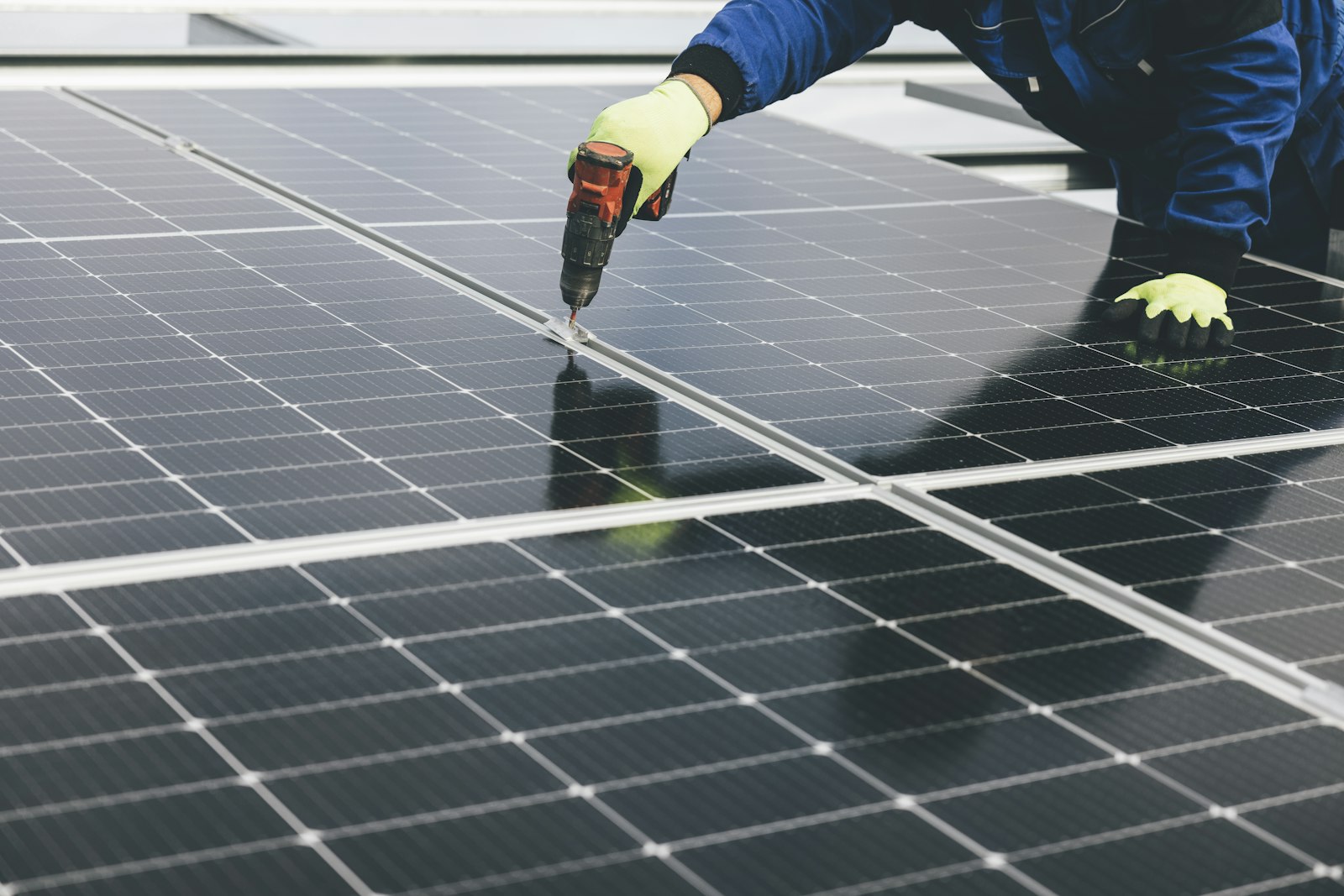
A Green Way Solar engineer fixing panel rails on a flat commercial roof.
Roof loading, age and access are the first three things we check on any commercial building.
Step 6 of 6

Receive a tailored commercial proposal

After the assessment, a member of our team uses what they found on site to build a proposal designed around your building, your energy use and your commercial objectives. This is the stage where the indicative figures on this page are replaced by modelled ones.

  • Detailed site survey findings
  • Bespoke system design
  • Accurate generation modelling
  • Financial projections
  • Asset finance options where appropriate
  • Battery storage recommendations where appropriate
  • EV charging recommendations where applicable
  • Installation proposal and next steps
FirstWe visit and survey the building
ThenAn engineer designs the system
FinallyYou receive a tailored proposal
Good to know

Commercial solar FAQs

No. It is an indicative overview built from typical commercial benchmarks and two answers about your building. It exists to show you whether the opportunity is worth investigating. A firm figure needs a site survey and an engineer-led design.

Half-hourly consumption data if you have it, a roof plan or drawings, the age and construction of the roof, your current supply arrangement and your existing grid connection capacity. If you have none of those, we start with the site visit.

Often, yes, but landlord consent comes first and the arrangement matters: who owns the system, who takes the benefit, and what happens at lease end. If you are the landlord rather than the tenant, choose the Commercial Landlord card, because the standard savings model does not apply to you.

It happens, particularly on rural sites and constrained networks. An export limit does not stop a project, it changes the design. We size closer to your own consumption, and battery storage or load shifting usually does more work in the business case.

Yes. We install Gullwing, Concrete-Bolted and Ground Screw canopy systems, with or without integrated EV charging. They cost more per kWp than a roof, so we are upfront about where they do and do not stack up.